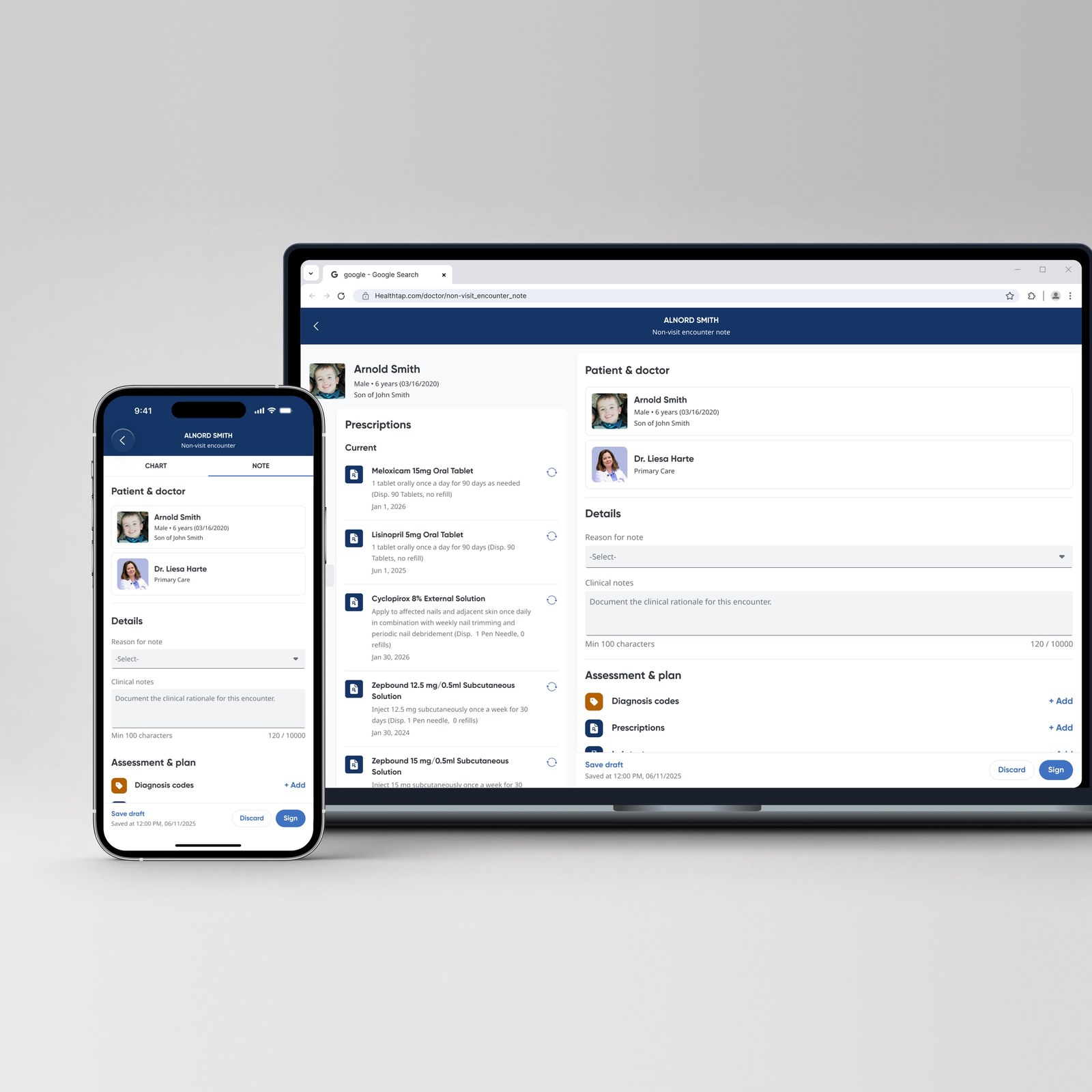
HealthTap · New service design
Virtual primary care
- Shipped
- 1-month research, 6-month design + eng (07.2020 – 01.2021)
- Lead product designer
- 2 PM, 6 front-end engineers, 1 back-end engineer
- Web, iOS, and Android

- Background
- HealthTap provided 24/7 on-demand virtual urgent care to individual consumers and to partner employees.
- Problem
- Subscribers cancelled right after their first visit. Urgent care is by nature something you need rarely, so nothing held people to the subscription.
- Approach
- Designed a virtual primary care service around a lasting doctor–patient relationship rather than a one-off transaction — then A/B tested that premise against the alternative.
- Outcome
- MVP 01.2021, official launch 03.2021. Retention, revenue and conversion all moved together over the following six months.
Problem
High subscription churn in virtual urgent care
HealthTap's 24/7 virtual urgent care worked — but urgent care is something you need rarely, so most subscribers cancelled after their first visit.
Our hypothesis: a full virtual primary care service could lower churn.

User research
User interviews to identify key factors target customers care the most
Interviews with target customers surfaced three factors, and the third one reframed the whole project.
Affordable, quick access
No insurance or a high-deductible plan, and the ability to see a doctor within two days.
A quality doctor
Nearly half of participants checked patient reviews and ratings before choosing a doctor.
The relationship
7 of 10 interviewees had more than two primary care visits with the same doctor in the past 12 months, because they trusted and felt comfortable with them.
“I have a high-deductible insurance plan, so I used to put off doctor visits because of the cost and long wait times. Virtual primary care is affordable. No surprise bills. I finally have access to a high-quality doctor I trust, without the financial stress.”
Michelle R, New York
“From the very first visit, I knew I had found the right doctor. She listened, remembered my history, and actually cared. In the last year I've had three visits with the same doctor. The ongoing relationship I've built with her has made me feel truly supported.”
Sarah M, California
Design strategy
Relationship-based primary care
Shift the experience from transactional, one-time visits to a virtual primary care model designed to build lasting doctor–patient relationships.
We focused the MVP on four experiences that make relationship-based care possible: a personalized home, seamless appointment booking, personal doctor assignment, and ongoing asynchronous messaging.


MVP design
The end-to-end virtual primary care flow
Step 1: Discover virtual primary care
The new architecture put paid care services at the top, with a carousel surfacing key events like upcoming appointments. It also removed features such as the Symptom Checker that served neither users nor the business.

Step 2: Choose my personal doctor
Research said people check ratings and reviews first. The question: lead with a browsable list, or send people into a full profile? Option A won — easier to compare by photo, rating and time, with fewer steps to the next stage.

Step 3: Scheduling and checkout first, intake later
Putting scheduling and payment ahead of the five-step intake drove conversion instead of losing people to a form.


Step 4: Join video visit
SMS and email reminders reduce no-shows, and an upcoming appointment section on the logged-in home screen lets users view, confirm, and join in one step.

Hypothesis validation
AB testing to validate relationship-based care
Rather than assume the strategy was right, we tested it. Version A led with the patient's personal doctor. Version B offered any available doctor.

Higher ratings
Version A received higher visit ratings than Version B.
More conversation
A higher volume of messages was exchanged between HealthTap doctors and patients.
Less transactional
Version B's approach proved more transactional in nature — which was exactly the churn problem we started with.
Impact
What changed after launch
MVP launch 01/2021, official launch 03/2021. Six-month performance compared with the previous period.
“It's not a random app doctor — I always see the same doctor who listens and understands my conditions. It's worth much more than $15 a month.”
Shirley T, Texas
“Best doc I've ever had. Love her. She is so kind, compassionate and loving! I want to see her all the time! So proud she's my doc! Also I feel like she's my friend! We love you and thank you from the bottom of our heart!”
Rhonda M, New York
More projects